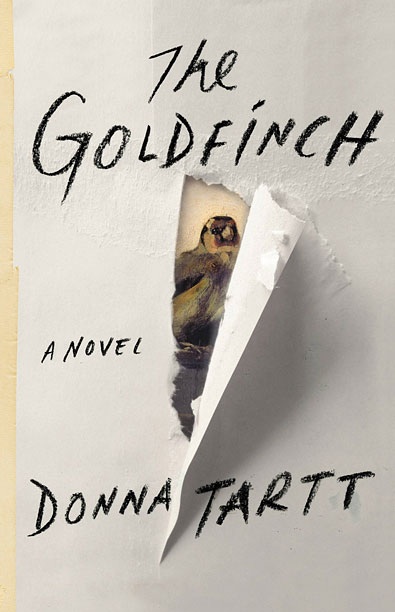
I suppose in the old days, of book shops and spare time, I would have idly wandered into a chain book store, seen the new Donna Tartt book, read the back, bemoaned the price and gone on my merry way. But things are different now. I downloaded the free sample, read it, downloaded the rest, and read that too. I finished the book breathless, different, feeling alive. Not many books can do that, in whatever format you choose to read them.
I loved Donna Tartt’s first novel, The Secret History, but was somewhat disappointed with The Little Friend, her second. It felt too claustrophobic, too long, too contrived. But The Secret History was the kind of book that when you found out someone else liked it, you liked that person a bit more. Eleven years after The Little Friend, The Goldfinch was published. I kept reading good reviews and decided to download that free sample, hoping for an experience closer to her first novel than her second. I got something completely different.
Ostensibly (I love that word), it’s a story about a boy – Theo – and a painting of (you guessed it) a goldfinch. But the boy is involved in a terrorist incident that kills his mother, and the painting isn’t just any old work of art, but a sublime masterpiece. The story follows Theo in the aftermath of his mother’s death, lost in Manhattan, to the return of his scoundrel father and relocation to Las Vegas, and eventually back to New York and over to Amsterdam, where the issue of the painting – and Theo’s place in the world – may be resolved once and for all.
That’s quite a dainty paragraph to describe the book when it’s so much more than that. It’s a rumination on life, love, existence, beauty and connections; connections between people, places, and objects of desire. I’m going to discuss a few things that really stood out for me in the rest of this post; there may well be spoilers. So watch out!
Any book that is set in New York appeals to me. It is simply one of the best cities in the world. The love that Theo feels for his mother is so closely entwined with his love for the city that he finds it impossible to see the city without her in it. The descriptions are terrific – of the cold, the darkness and oppression in winter, the infinite variety of Manhattan itself. And how familiarity can disappear so quickly. After Theo returns to New York after Las Vegas, he can’t quite believe how cold it is; how his old building is being renovated; how things have changed without him. After all he’s been through by now, this discombobulation feels terrifying. Where is home when your home changes without you? If his home was his apartment, and his mother, where can he call home now?
I spent the first part of this novel on the verge of tears. The fear, loneliness and desolation that Theo feels after his mother is killed in an explosion is heart-wrenching. Memories of her triggered by bottles of shampoo, books he spies in a stranger’s office, a restaurant they had lunch in once. His realisation that she isn’t coming back is written so beautifully that your heart breaks a little for him, a dull ache in your chest at the loss he’s feeling. To be dropped into the patrician coldness of the Barbour’s home (even their name is a waterproof coat – how much emotion are they going to let in?) is some relief – at least he’s not on the streets, at least he’s not in care – but no large apartment and beautiful antiques will replace his mother.
But the painting. The explosion that killed Theo’s mother happened in the Met, where an exhibition of old master paintings was being held. In the aftermath, Theo comforts an old, dying man, who appeared to be the guardian, or uncle, of a girl he spied earlier. The man gives him his ring, and Theo takes it. He also takes The Goldfinch. The ring eventually leads Theo to Hobie, an antique restorer, and to Pippa, the girl he saw in the museum. But the painting is a secret. Presumed to be destroyed in the explosion, it soon comes to light that it might have been looted, just as other paintings were. The guilt Theo feels is obviously for surviving, not just for taking the painting. Perhaps the painting, its uniqueness and beauty, is the closest Theo can get to getting his mother back. It was her favourite, after all.
Just when Theo is settling in at the Barbour’s, his father returns. He has a trashy girlfriend in tow, oozes with latent alcoholism and reduces Theo’s beloved ex-home to boxes, after he’s sold off all his mother’s belongings. And then they leave – with the painting. No more Pippa, who Theo is starting to love, and no more Hobie, the only adult Theo really likes.
The haziness and heat of Vegas, the surreality of it all is brilliantly evoked by the author – as is Theo’s descent into drugs and alcohol abuse, terrifyingly neglected by a father who seemingly only wanted his son to antagonise a dead woman. Theo’s salvation and enabler is Boris, an equally neglected expat boy who helps Theo out of his misery by leading him towards drugs. Is Boris good? Perhaps not, but he is there for Theo when no one else is. The two are forced to scramble and steal food, becoming malnutritioned and barely getting into school, the opposite of Theo’s honour roll classes back in New York. The desert encroaches, the vast dryness and emptiness of their lives slowly overwhelming them, far away from the glitz and glamour that the Las Vegas lie feeds us so willingly.
Another twist of fate and desperation returns Theo to New York, to Hobie. Pippa is gone. The Barbours have their own problems. And the painting? Well, you’ll have to read to find out.
The Goldfinch is the kind of book which generates such emotion – you’ll read it again but never for the first time, never feel those things in the same way. But you’ll appreciate and see the finer details – just like getting to know a painting well. It’s the kind of book that makes you want to write, to try and emulate the creation, like poor tennis players in the shadow of Wimbledon. But it also makes you never want to write, because the chances of creating something this beautiful, your own goldfinch, are so low. Wonderful, painful, beautiful.
A few other thoughts I had:
I’ve not really talked about Hobie much in the paragraphs above, but his influence in the book – as a creator of beauty, as a steady moral influence and also as a person Theo feels at home with – cannot be understated. Are the pieces of furniture Hobie builds any less valuable than the traditional pieces the two sell in their shop? Is provenance really all? If something is beautiful, does it matter where it came from? The art and beloved items in Theo’s home before he had to leave would say that beauty is in the eye of the beholder, not in the box of sale receipts and provenance proofs.
Pippa is a musician, but the explosion stops her from playing. The cruelty of no longer being able to create beauty is particularly harsh.
The different styles of parenting were extraordinary – from the close and wonderful relationship Theo had with his mother, to the cool, distant style of the Barbours. Theo’s father barely acknowledged his existence once he arrived in Vegas – indeed, the house was barely furnished, only the basics provided, and even food wasn’t considered. Is this dereliction of duty the ultimate parental betrayal? Excluding Theo’s mother, who is the best parent in this novel? Why?
Consider that compared to New York, there was nothing – literally, nothing – for Theo to do. Is it any surprise that drugs and drinking were the only activity for him and his peers? What responsibilty do the parents have for this kind of cultural stimulation? I found the extent of the drug taking and drinking appalling – indeed, some of it only came to light later in the book, when Theo met Boris again. Were they just bored in Vegas, or was there a subconcious wish to die?
Boris could be seen as the bad influence, but again he was the victim of parental neglect. What would have happened to Theo if he’d never met Boris? Who really succeeded in life, when they met again? Boris may well have been living a not-entirely legal life, but he seems a lot more alive than Theo, still in a drugged stupor.
Is guilt about the painting the reason that Theo continues to use drugs? Or is it his feelings for Pippa? When you covet something beautiful, is it better to keep it to yourself once you get it, or to let it go back into the world? Consider art, lovers, and even children…
The novel has its redemption – the painting is recovered, Theo appears to be clean, issues are resolved with Hobie. But still no Pippa. Theo changes from being grounded in one place to flying around the world, birdlike himself. What will happen with him next?

 Yeah! No. I Don't Know?