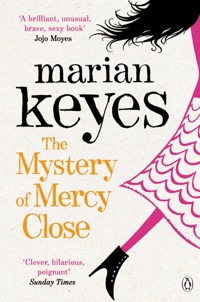
I always think that the publishers of Marian Keyes’ novels do her a disservice. The covers are pastel coloured affairs that visually declare themselves to be chick lit, that noughties equivalent of a 1980s bonkbuster. Instead of sex and shopping with a career minded bitch, however, you get a frothy shop fest, with the heroine satisfied with a bland man and a newly discovered passion for a little light baking.
The first time I read one of her novels I was actually shocked. I was in the mood for a frothy shop fest, perhaps one that would awaken my latent cupcake creator, and instead I had a book that dealt with alcoholism (This Charming Man) in a way that I’d never read before. Written beautifully, with the alcoholic actually a woman and a mother, and dealing with all the prejudices that this entails, it’s constructed in such a way that for a while you don’t even realise that she is one with the problem. Since then I’ve devoured her novels, and while they do have happy shopping moments in them, you certainly get more than you bargain for from her books.
A few years ago Marian Keyes announced that she suffered from depression and would be taking a break from writing. Since then, she’s published a book on cakes (the baking and eating of which saved her life) and now this. Looking at the life of Helen Walsh, one of the Walsh sisters that her books feature frequently, it is ostensibly a mystery about a missing boy band member, who disappears only a few days before the reunion gig. Helen Walsh is a down at heel private detective and is given the job to find him by an old flame. But Helen suffers from depression. Properly suffers. Will this work tip her over the edge and take away the few good things in her life?
You can’t help but read this book and just feel that Marian is writing from her own experience. The slow stupor of depression, the matter-of-factness about the nihilism of life and how exhausting just getting out of bed can feel is all dealt with honestly, terrifyingly and beautifully. You root for Helen in a way that you cannot for the supposed protagonist of the book, the missing boy band member. Never has a character in a supposed chick lit book (a term that I hate) made you want to hug them more.
The book also touches on the economic situation in Ireland, the obligations one feels to family and friends and how money can get in the way, and does so with a deftness of touch that many books that consider themselves to be serious fiction would be glad to manage.
The point to this book isn’t whether the boy band member will be found and the gigs will happen, but if Helen will survive. Look past the soufflé light tale of gigs and rehearsals and a good, good read about life reveals itself.
Some things to discuss…
1. Helen describes the different ways her family and friends reacted to her depression in the past. Is this the main reason she doesn’t want to tell them how she is feeling now? Does she see depression as a weakness or illness? Has she changed her mind about how she sees depression herself?
2. Home gives Helen a sense of self. How does losing her home contribute to her emotional state? Contrast her flat with her parents’ house and how they treat her, and again with Artie’s home. Is she really at home anywhere? Even at Mercy Close?
3. The economic depression has a huge role in this book, yet, like depression, talking about it is just not done. How connected are the two issues? Consider Jay and how he has changed, how the boy band members have dealt with their time out of the spotlight. Is putting on the right show – with depression and lack of money – more important than actually dealing with the problem properly?
4. Some of the most striking scenes in the book deal with suicide and Helen’s thoughts about it. The writing here becomes quite objective and stark. Do you think that this style of writing suits the purpose, or did you expect it to be emotional? Is the fact that the writing here is so honest make it more hard hitting or less believable?
5. Helen is regarded as the odd one out in her family. Do you think depression can mark itself in such a way or is it a quieter disease? Do you think you have to have an ‘event’ to cause depression or is it latent in people?
6. How important to Helen are her male relationships? Did you think that her relationship status would be different by the end of the book? How important are her female relationships, excluding family? What did you think of Bronagh?
7. Marian Keyes is a big believer in talking openly about depression and frequently does so on Twitter, saying if she has a bad day. Do you think she can do this because she is famous? How would you feel if one of your friends regularly talked about depression?

 Yeah! No. I Don't Know?